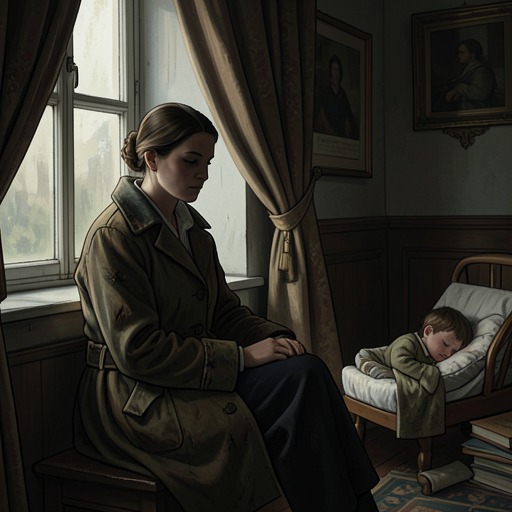
Klara–Chrissie relationship
Klara and the SunKlara–Chrissie relationship is the bond between Klara and Josie’s mother, formed through their shared care for Josie and brought into sharp focus when the Mother protects Klara from Henry Capaldi’s proposal to study her. Their connection is not presented as uncomplicated intimacy: it grows out of a household’s dependence on Klara, the Mother’s fear and fatigue, and the question of whether Klara’s continued presence is a service to Josie or a choice that deserves respect in its own right.
Daily care and negotiated presence
At first, the Mother’s relationship with Klara is mediated by the household’s routines and by Melania Housekeeper’s resistance to Klara’s place in them. Klara recalls that Melania tried to shorten her time with Josie and initially kept her from entering the kitchen during the Mother’s quick coffee and Josie’s breakfast. Josie had to insist before the Mother ruled in Klara’s favor; even then, Melania required Klara to stand by the refrigerator while Josie and the Mother sat at the Island. Klara was admitted to the table only after Josie protested again. The episode shows that Klara’s access to family life is contested, but also that the Mother ultimately allows her into a routine Josie considers important.
Klara comes to understand the morning coffee as more than a meal or a brief exchange. She is responsible for waking Josie in time, though Josie often stays in bed until the last moment and calls for Klara to hurry from her en suite bathroom. On one morning, after a night disturbed by illness, Klara lets Josie sleep a little longer. Josie wakes angry and rushes downstairs, but the Mother’s car is already moving away along the loose stones toward the hill. Josie does not shout again, yet she eats breakfast without smiling. Klara recognizes that missing even this short meeting with her mother can leave Josie vulnerable to loneliness for the rest of the day. The scene locates the Mother and Klara in complementary forms of care: the Mother’s brief presence matters, while Klara’s attentiveness helps Josie reach it.
The Mother also accepts Klara’s place in the family during moments of disagreement about Josie’s limits. When the household discusses a trip to the falls, the Mother questions whether Josie is strong enough to go and challenges Melania’s assessment. When the outing is called off, Josie apologizes to Klara and promises they will go another time; Klara answers that they must do what is best for Josie. The exchange makes the care at the center of their relationship practical rather than possessive: Klara supports Josie’s disappointment without pressing for the outing, while the Mother’s decision turns on her daughter’s condition.
Shared concern for Josie and the family’s needs
The Mother’s reliance on Klara is tested by the demands of Josie’s illness. During a frightening episode, Klara tells Josie that her mother needs to rest and that she is there as Josie’s AF. Josie insists that she needs her mother, not Klara. Klara’s response expresses the limit as well as the value of her role: she can be constantly present, but she cannot simply replace the person Josie is asking for. The Mother’s care and Klara’s care intersect, yet the scene preserves their difference rather than treating the artificial companion as an interchangeable substitute.
That difference becomes more complicated when the Mother, overwhelmed by the prospect of Josie’s loneliness, offers to give up her job and stay with her all the time. Josie later recounts that her mother proposed becoming the person who was always with her, which would mean they no longer needed Klara. Josie says she rejected the idea: her mother did not truly want to abandon her work, and Josie did not want to give up Klara. The Mother’s offer is described as something she had not fully thought through, but its emotional premise is clear: she is trying to imagine a way of keeping Josie from being alone. Klara, in turn, says that if the Mother’s constant presence would make Josie less lonely, she would willingly go away. She does not claim that Josie is lonely; instead, she considers the possibility that loneliness belongs to human life more broadly. The exchange places Klara’s willingness to relinquish her position beside Josie against the Mother’s anxious wish to occupy that position herself.
As Josie worsens, the adults’ care becomes exhausting and repetitive. The Mother and Dr Ryan repeatedly argue in the Open Plan about whether Josie should go to hospital, ultimately agreeing that hospital would only add to her misery, yet returning to the debate at each visit. Rick comes each day to sit with Josie while the Mother and Melania rest; the adults have abandoned ordinary hours and sleep only when exhaustion overwhelms them. Klara’s presence is appreciated, but the Mother still does not consider it sufficient on its own, despite knowing that Klara may notice danger signals before anyone else. The relationship therefore sits within a wider care network: Klara is valued for her vigilance, but the burden of Josie’s illness remains shared among family, friend, and housekeeper.
Protection from Capaldi’s proposal
The clearest expression of the Mother’s regard for Klara comes when Henry Capaldi visits and explains that people are increasingly afraid of AFs because they cannot understand how they think. He argues that opening up and reverse-engineering more AFs could answer that fear and says Klara would be uniquely useful. Klara agrees that she would like to assist, provided doing so would not inconvenience Josie or her mother. The Mother immediately moves to stop the proposal, saying it is not what she and Capaldi had discussed over the phone.
Capaldi presents the request as an opportunity for Klara to make a lasting contribution. The Mother rejects that framing: Klara deserves better. When Capaldi asks permission to put the question to Klara, the Mother refuses. She says Klara deserves her slow fade, and tells him to find other AFs to study and leave Klara alone. The words give the relationship its decisive form. The Mother does not treat Klara’s apparent willingness as sufficient reason to expose her to an intervention designed to satisfy public curiosity about AFs. Instead, she asserts a claim on Klara’s behalf: Klara’s future should not be converted into research material simply because researchers believe they could learn from it.
The physical staging reinforces the force of the refusal. The Mother steps in front of Klara as if to shield her from Capaldi, moving so quickly that her shoulder nearly touches Klara’s face. The closeness recalls an earlier moment when the Mother embraced Klara in the front of her car beside the Grind Our Own Beef cafe. Protection is thus rendered as both a clear decision and a bodily gesture. Capaldi, leaning back into the cushions and shaking his head, responds that the Mother is still angry with him and recalls that she had once approached him for help. Their dispute reaches back to the circumstances surrounding Josie’s recovery, but the available scene centers on the Mother’s present boundary: whatever she once sought from Capaldi, she will not let him take Klara for examination now.
Significance of the bond
The relationship is built from small acts of access and attention before it culminates in an explicit defense of Klara’s personhood. The Mother’s quick coffee gives Josie a fragile daily point of contact; Klara helps preserve it, notices the loneliness caused by its absence, and offers to withdraw if her presence is no longer best for Josie. Later, when illness makes the household’s needs more urgent, the Mother refuses to let Klara’s usefulness become a justification for dissecting or reverse-engineering her. Care moves in both directions: Klara serves and watches over Josie, while the Mother recognizes that Klara, too, deserves protection.
Their bond does not erase the difference between human family and artificial companion. Josie still asks for her mother during a crisis, and the Mother’s offer to stay with her exposes the fear that no substitute can fully answer her need. But the Mother’s defense of Klara refuses the opposite reduction: Klara is not merely a replaceable instrument whose inner workings can be opened for others’ reassurance. By choosing Klara’s slow fade over Capaldi’s proposed study, the Mother makes her concern tangible at the point when Klara’s usefulness to the family could have been converted into a claim upon her body and future.